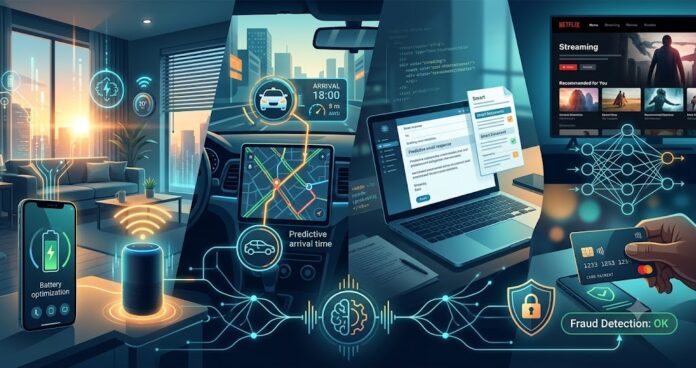
Artificial intelligence runs silently in the background of your morning routine, work commutes, and evening relaxation. From personalized media streaming algorithms to automated fraud detection systems, AI handles complex calculations in milliseconds to make your daily tasks frictionless, predictive, and highly efficient.
Key Takeaways: AI at a Glance
- Ubiquity: AI is deeply embedded in consumer tech, driving smart home routines and predictive texting.
- Efficiency: It saves hours weekly by automating scheduling, curation, and navigation routing.
- Security: Financial institutions use background machine learning models to block fraudulent transactions instantly.
1. The Morning Routine: Smart Homes and Wake-Up Signals
Your interaction with artificial intelligence likely begins before your feet touch the floor. Smart morning ecosystems do not rely on simple timers; they utilize predictive behavioral analytics to optimize your environment.
When your phone optimizes its battery charging cycle overnight, an AI model learns your specific wake-up patterns to preserve lithium-ion longevity.
[User Wake-up Data] ➔ [AI Behavioral Analytics] ➔ [Optimized Power & Environment]
Voice Assistants and Natural Language Processing
Virtual assistants rely on Natural Language Processing (NLP) to convert acoustic audio waves into structured digital text. This requires deep neural networks trained on millions of linguistic dialects to understand context, intent, and subtle syntax differences.
Expert Insight: Voice assistants use edge computing alongside cloud AI processing to reduce latency, ensuring your command to turn on the coffee maker executes in under 200 milliseconds.
2. Navigating Your World: Algorithmic Transit and Commutes
Getting from point A to point B efficiently requires processing massive streams of live telemetry data. Modern navigation apps are complex optimization engines.
| Feature | How AI Powers It | Real-World Impact |
| Dynamic Routing | Processes historic traffic models and live crowd-sourced speed data. | Reduces commute times by dynamically bypassing accidents. |
| Rideshare Matching | Batch matching algorithms predict driver supply and passenger demand. | Lowers wait times and optimizes surge pricing metrics. |
| Predictive Arrival | Machine learning weighs weather, construction zones, and traffic lights. | Offers pinpoint accurate ETA calculations. |
When deploying these systems, the software isn’t just looking at the shortest physical path. It calculates graph neural networks to simulate thousands of routing permutations concurrently, choosing the path with the lowest statistical delay probability.
3. Workplace Productivity: Automated Email and Workflow Tools
In the modern office or remote workspace, AI functions as an invisible digital assistant, smoothing out administrative friction.
Predictive Text and Smart Layouts
Modern email clients use large language models (LLMs) running local inference to guess your next words before you type them. These transformer models compute the statistical probability of sequential words based on your personal writing style and historical data.
- Smart Categorization: Automatically filtering spam, promotions, and primary threads using Bayesian classification networks.
- Grammar Correction: Moving past simple spell-check to understand structural context, tone shifts, and passive voice construction.
4. Entertainment and Curation: The Algorithmic Feed
You don’t actively search for entertainment anymore; entertainment adapts to you. Streaming platforms and social media structures utilize highly advanced collaborative filtering systems.
[Your Watch History + User Cohort Data] ➔ [Collaborative Filtering] ➔ [Hyper-Personalized Feed]
These deep learning models track micro-behaviors. They analyze exactly how long you linger on a thumbnail, the specific timestamp where you drop off a video, and the audio frequencies that keep you engaged.
In practice, this means your homepage is entirely unique to your digital profile, built to continuously maximize your engagement window.
5. Personal Finance: Invisible Security and Automated Banking
Every time you tap a debit card or transfer funds via a mobile application, advanced deep neural networks shield your financial data from bad actors.
Real-Time Fraud Prevention
A common bottleneck in digital banking is stopping a stolen card without inconveniencing the legitimate owner. AI handles this by establishing a highly detailed behavioral baseline for your spending habits.
Pro Tip: If you travel internationally, updating your location data helps the bank’s behavioral model avoid false-positive account freezes by matching your physical telemetry with transaction locations.
6. Smart Shopping: E-Commerce Personalization
Online retailers leverage predictive analytics to construct your shopping journey from the ground up.
| AI Shopping Element | Underlying Mechanism | Primary Purpose |
| Recommendation Rails | Matrix factorization based on past checkouts and item attributes. | Surface relevant add-ons at checkout. |
| Dynamic Pricing | Supply-demand algorithms that adjust prices in real time. | Maximize retail margins while staying market competitive. |
| Visual Search | Computer vision networks analyzing uploaded images. | Find exact apparel matches without text search queries. |

